
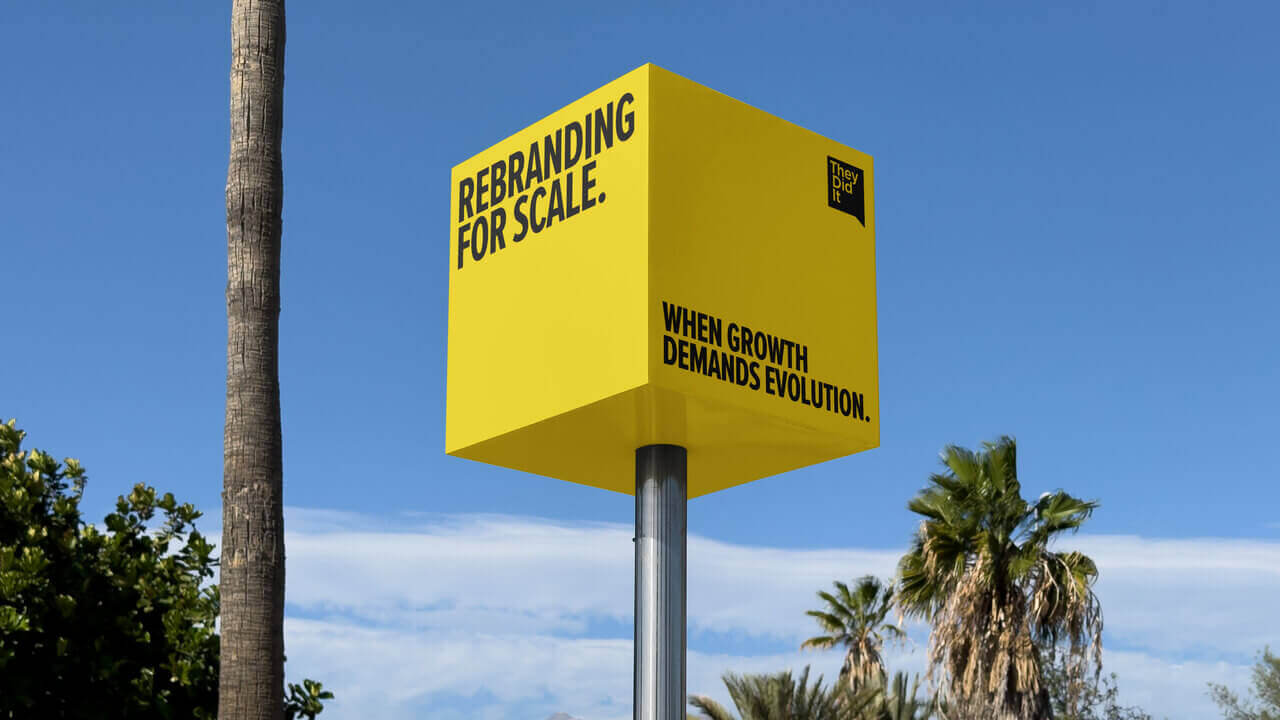
Rebranding for scale, when growth demands evolution
Rebranding is often framed as a last resort.
A reaction to decline.
A fix for something broken.
In reality, the most successful rebrands happen when a business is growing — not failing.
At They Did It, we see rebranding as a strategic response to evolution. It’s what happens when a company outgrows its original story, market position, or visual identity and needs clarity to scale into its next phase.
Growth changes businesses.
Brands must change with them.
Why Growth Creates Brand Misalignment
Early-stage brands are built quickly:
- Founder-led narratives
- Intuitive positioning
- Rapid decisions
As growth accelerates:
- Teams expand
- Markets diversify
- Offerings evolve
- Leadership structures change
What once felt authentic begins to feel limiting.
The brand no longer reflects reality — and that gap creates friction.
The Real Cost of Not Rebranding
Avoiding rebranding when it’s needed doesn’t preserve stability — it delays correction.
Common consequences include:
- Slower sales cycles
- Confused market perception
- Inconsistent messaging across regions
- Internal disagreement on direction
- Difficulty entering new categories or markets
Eventually, growth stalls not because demand disappears, but because clarity does.
Rebrand vs Brand Refresh: Knowing the Difference
One of the most important distinctions to make is between a brand refresh and a rebrand.
A brand refresh:
- Updates visual expression
- Modernises tone
- Retains core positioning
A rebrand:
- Repositions the business
- Redefines value
- Aligns brand with future strategy
Choosing the wrong approach leads to cosmetic change without commercial impact.
Signals That a Rebrand Is Needed
Businesses rarely wake up wanting to rebrand.
They notice symptoms first.
Common signals include:
- “We’re being misunderstood in the market”
- “Our brand feels dated or limiting”
- “Our messaging no longer reflects what we do”
- “We’re entering new markets and nothing aligns”
- “Sales conversations keep starting from scratch”
These are not design problems.
They are strategic ones.
Rebranding Is a Leadership Exercise
Rebranding cannot be delegated without direction.
It requires leadership alignment on:
- Where the business is going
- What it stands for
- What it will no longer be
- What success looks like in the next phase
Without leadership clarity:
- Teams resist change
- Execution fragments
- Consistency collapses
Strong rebrands start at the top.
Strategy Before Expression
Visual change without strategic clarity creates confusion.
Effective rebranding begins with:
- Positioning analysis
- Competitive context
- Customer perception
- Internal reality
- Future ambition
Only once these are aligned does expression become meaningful.
Design amplifies clarity — it cannot create it.
Protecting Momentum During a Rebrand
One of the biggest fears around rebranding is disruption.
When done correctly, rebranding protects momentum by:
- Clarifying direction
- Equipping sales teams
- Aligning marketing efforts
- Enabling consistent execution
The key is phased implementation — not abrupt change.
Avoiding Cosmetic Rebrands
Cosmetic rebrands focus on surface-level change:
- New logo
- New colours
- New website
Without strategic alignment, these changes:
- Fail to land
- Confuse existing customers
- Create short-term noise
- Require rework within months
Rebranding must address meaning before aesthetics.
Rebranding for Global and Multi-Market Growth
For businesses expanding internationally, rebranding often becomes unavoidable.
Markets expose:
- Inconsistent positioning
- Localised improvisation
- Weak central narratives
Rebranding creates:
- A strong global core
- Flexible local execution
- Brand systems that scale
This is where rebranding becomes growth infrastructure.
How We Approach Rebranding at They Did It
Our approach is deliberate and commercially grounded.
We focus on:
- Strategic repositioning aligned to growth goals
- Leadership alignment and decision-making
- Brand systems designed for scale
- Clear narratives for customers, partners and teams
- Expression that reflects reality — not aspiration alone
Rebranding is not about becoming something else.
It’s about becoming clearer.
The Long-Term Value of Rebranding Well
A successful rebrand:
- Re-energises growth
- Improves perception
- Shortens sales cycles
- Strengthens pricing power
- Aligns teams around direction
It becomes a platform — not a project.
Conclusion: Rebranding Is an Investment in the Next Phase
Rebranding should never be reactive.
It should be intentional, strategic, and leadership-led.
When growth demands evolution, clarity becomes the most valuable asset a business can invest in.