
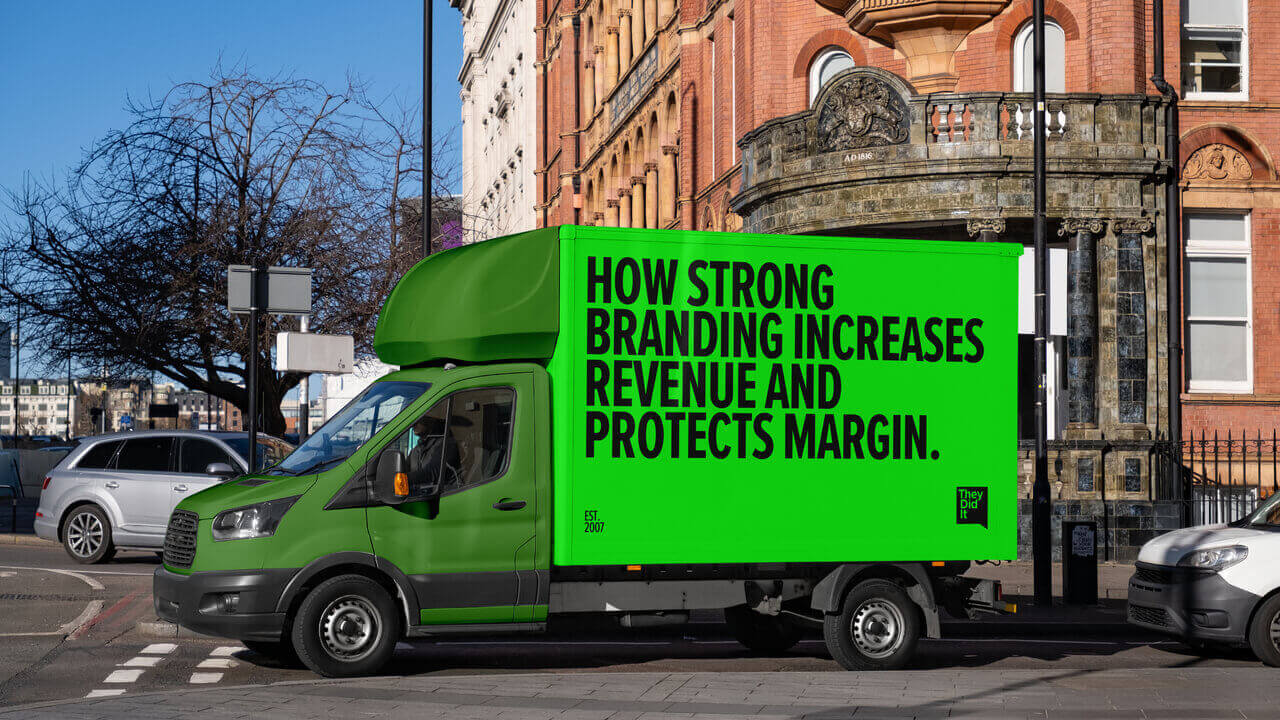
How strong branding increases revenue and protects margin
Branding is often categorised as a “soft” discipline.
Creative. Subjective. Hard to measure.
Yet the businesses that scale most efficiently tend to share one thing in common: strong brands that make commercial outcomes easier.
At They Did It, we see branding as a revenue lever — one that influences how quickly deals close, how confidently prices are defended, and how sustainably growth compounds.
When branding is weak, revenue leaks quietly.
When branding is strong, revenue accelerates.
How Brand Clarity Shortens Sales Cycles
Sales cycles lengthen when buyers need to work too hard to understand:
- What a business does
- Why it’s different
- Why it’s credible
Brand clarity removes this friction.
When positioning is clear:
- Sales conversations start at a higher level
- Objections are reduced
- Trust is established earlier
- Momentum builds faster
Strong brands allow sales teams to spend time selling — not explaining.
Branding and Trust: The Hidden Multiplier
Revenue is a function of trust.
In B2B and high-value consumer markets, buyers assess risk long before they assess features.
A strong brand signals:
- Stability
- Professionalism
- Confidence
- Long-term intent
This perception reduces perceived risk, which directly influences buying decisions.
Trust accelerates revenue.
Pricing Power Comes from Positioning
Businesses with weak brands compete on price.
Businesses with strong brands compete on meaning.
Clear positioning:
- Frames value before cost
- Shifts conversations away from discounting
- Allows premiums to be defended with confidence
This is not about charging more arbitrarily.
It’s about making value unmistakable.
Strong brands protect margin by defining relevance.
The Cost of an Unclear Brand
Brand ambiguity creates hidden commercial costs:
- Longer sales cycles
- Increased acquisition spend
- Discount-driven conversions
- Lower lifetime value
- Inconsistent market perception
These costs rarely appear on a P&L — but they compound over time.
Brand clarity reverses this.
Branding as a Sales Enablement Tool
Strong brands equip sales teams.
With clarity, sales teams gain:
- Clear narratives
- Consistent language
- Strong differentiation
- Confidence in conversations
This alignment increases conversion rates and improves deal quality.
Sales and brand are not separate functions.
They are mutually reinforcing.
Brand Consistency and Revenue Predictability
Consistency builds familiarity.
Familiarity builds trust.
Trust builds predictable revenue.
Brands that execute consistently across:
- Touchpoints
- Markets
- Channels
experience more stable growth because buyers know what to expect.
Consistency reduces volatility.
Branding and Customer Lifetime Value
Strong brands don’t just acquire customers — they retain them.
Clear brands:
- Set accurate expectations
- Build emotional connection
- Encourage loyalty
- Reduce churn
This increases customer lifetime value, making growth more efficient.
Brand as a Defensive Asset
In competitive markets, branding becomes a defensive asset.
Strong brands:
- Withstand new entrants
- Resist commoditisation
- Recover faster from disruption
When markets tighten, brand strength often determines who survives — and who leads.
Measuring the Commercial Impact of Branding
While branding is not always directly attributable to a single metric, its impact is visible through:
- Improved conversion rates
- Reduced sales cycle length
- Higher average deal size
- Improved retention
- Stronger inbound lead quality
These indicators reflect brand clarity in action.
How We Approach Revenue-Led Branding at They Did It
Our work is commercially grounded.
We focus on:
- Aligning brand strategy with growth objectives
- Clarifying value propositions
- Strengthening positioning to defend margin
- Creating systems that support sales and marketing
- Ensuring consistency across revenue touchpoints
Branding should make growth easier — not harder.
Branding Is Not a Cost Centre
Treating branding as a cost limits its impact.
Treating branding as a growth investment unlocks its value.
Strong brands:
- Sell faster
- Defend price
- Scale more efficiently
This is not theoretical.
It is observable.
Conclusion: Revenue Follows Clarity
Strong branding does not replace great products or services.
It ensures they are understood, trusted, and valued.
Revenue follows clarity.
Margin follows confidence.
If growth feels harder than it should, the problem may not be demand — it may be clarity.